
Scratch
Games based learning provides students with an opportunity to meet learning outcomes through the use of activities that incorporate game play characteristics and principles. Whereas gameification involves game like elements into orthodox learning activities (Park, 2018). According to Gee (2015), well developed games are those that incorporate the following: feedback, perseverance, accessibility, reward and challenge, whilst also being fun and aesthetically pleasing.
What is it? Scratch is a visual programming tool which uses block based language and coding to develop interactive animations and games, it is specifically targeted at primary students. Scratch encourages creativity through the few limitations it has and the vast range of possibilities it encompasses for design. Also, through the use of coding, students are frequently encouraged to develop their problem solving skills (Squire, 2006).
Advantages and Disadvantages Scratch is an engaging tool that is more commonly being used in schools, it allows students to create multimedia products through the use of basic coding and programming skills, once created, students can also share or publish their products. Even though the coding seems basic, for those who haven’t had much experience with it, like myself, may struggle to understand how the program operates. However, after a quick tutorial students will be underway and able to uncover key features as they go. As mentioned above, the program requires students to use problem solving skills, which allows for development of computational thinking.
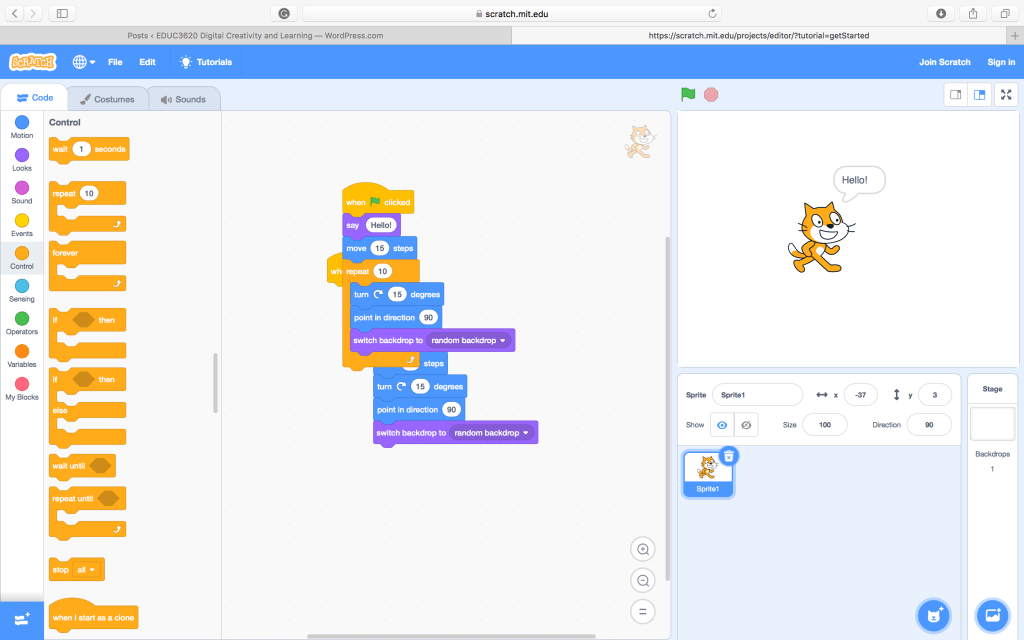
Classroom Implications For various projects, Scratch can be used to create a game for a topic or concept and in turn foster creativity, as students would need to utilise their imagination for their compositions. Scratch could also prove beneficial and engaging in an English lesson, for students to demonstrate aspects of their creative writing in a projects, or outline a story board. Also, Science in younger years, to create an animation to demonstrate a life cycle of plants growing, or perhaps in the maths classroom to create a game that contains mathematical elements, such as, a maze for other students to work their way through.
References:
Park, M., 2018. Gamification through minecraft. In: M. Park, ed., Gamification and Games-Based Learning, chapt. 17 [online] Ontario University of Technology. Available at: <https://techandcurriculum.pressbooks.com/chapter/minecraft/> [Accessed 4 May 2020].
 EDUC3620 Digital Creativity and Learning
